

At a glance
Starting Station
Shelford
Final Station
Cambridge
Walking Distance
Shelford → Cambridge South: ~3 miles
Cambridge station → city centre: ~1.5 miles (or take the bus)
Walking Difficulty
Easy
Suitable for
Adults, families with older children, science enthusiasts, history lovers
Refreshments
Cambridge South has a coffee van, and there are cafés on the Biomedical Campus
Treat yourself to lunch at the Eagle pub or one of the many restaurants in Cambridge City Centre
Highlights
World-changing Science • Public Art • Historic Cambridge • Walking & Rail Travel • Food & Drink
Duration
Half day to full day (4-6 hours)
Before you go
Check the train timetable for the day you are travelling
Check the bus timetable from Cambridge Station to the City Centre
Check the opening times for the Eagle and the Whipple Museum
Follow the story of the world's most famous molecule by train
Few scientific discoveries have changed our understanding of life as profoundly as the discovery of the structure of DNA. And remarkably, the story of that discovery is woven into the streets, buildings and railway journeys of Cambridge.
On this day out, you can follow in the footsteps of the scientists who helped reveal the secrets of life, from the DNA Path at Great Shelford, through the modern world of biomedical research at Cambridge South, to the historic heart of the city where James Watson and Francis Crick announced their discovery of the double helix.
Along the way, you’ll encounter the work of Rosalind Franklin and others whose research made the discovery possible, and discover how ideas developed over generations helped transform our understanding of heredity, evolution and what makes us who we are.
So hop on a train, lace up your walking shoes and follow the trail.
This is a journey through Cambridge, but it’s also a journey through the story of life itself.
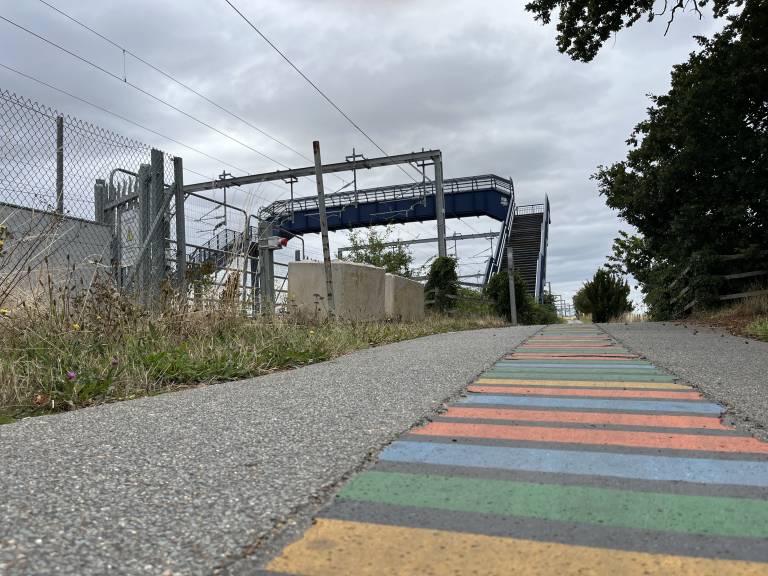
Starting point: Shelford Station
Step 1: Walk the DNA Path
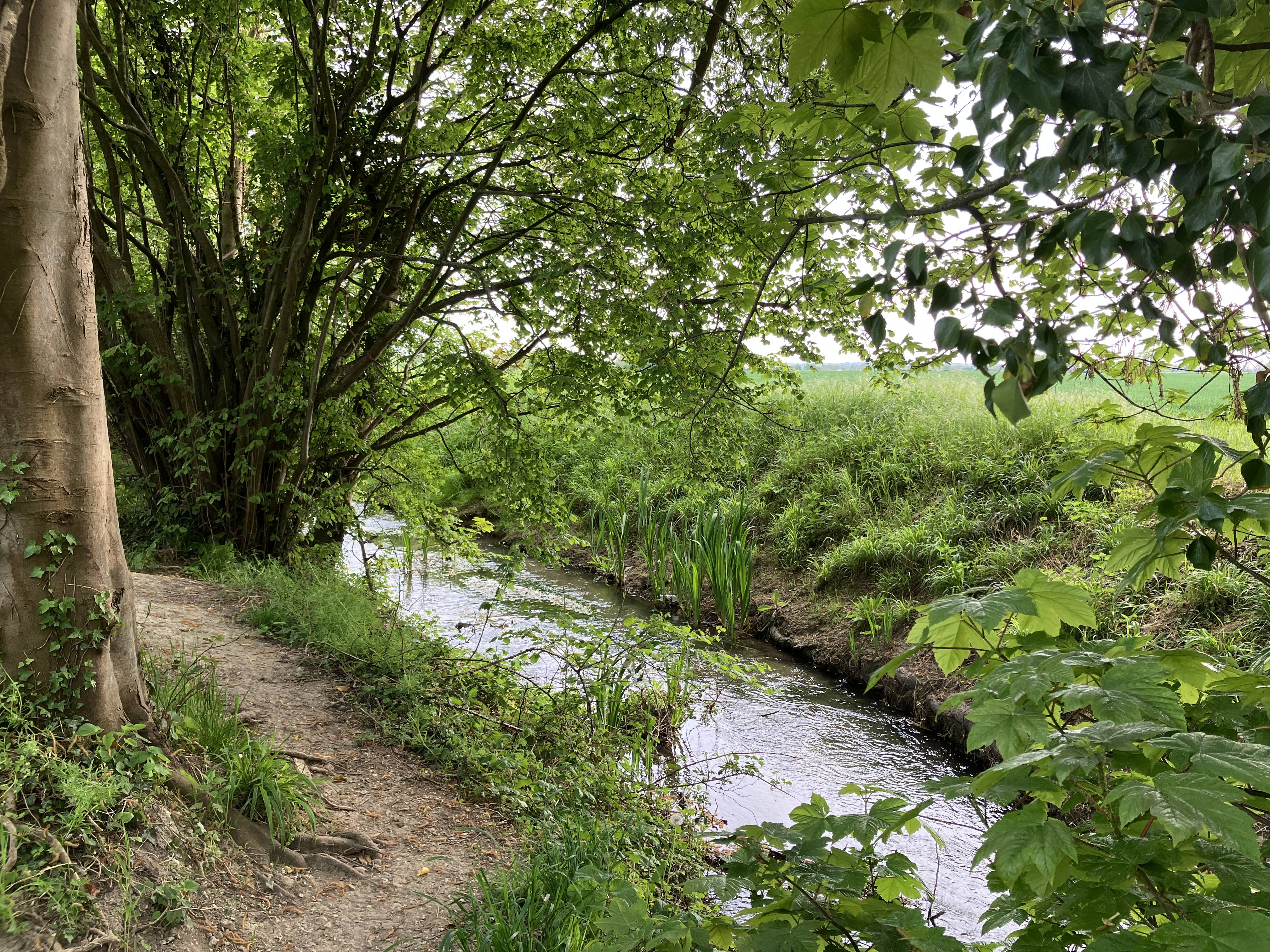
From Shelford station, follow the DNA Path north towards Cambridge South station.
Turn left out of the station onto Hinton Way, turn left onto Chaston Road, and left again as the road bends to the right. Pick up the DNA path at the end of the road. Cross Granham’s Road and pick up the path again on the other side. Carry on until you get to the Cambridge Biomedical Campus.
Distance: approximately 3 miles (5 km)
About the DNA Path
The DNA Path was opened in 2005 to celebrate the completion of the 10,000th mile of the National Cycle Network. It was created by Cambridgeshire County Council and Sustrans and links Addenbrooke’s Hospital and the Cambridge Biomedical Campus with Great Shelford, running alongside the railway for most of its route. It was officially opened by Sir John Sulston, the Nobel Prize-winning scientist who led much of the Human Genome Project in Cambridge.
The colourful stripes along the DNA Path represent the sequence of the BRCA2 gene, whose discovery involved scientists at Addenbrooke’s Hospital and the nearby Sanger Institute. Each stripe corresponds to one of the four building blocks of DNA, creating a giant piece of scientific artwork that celebrates Cambridge’s contribution to genetics and genome research.
Look out for the striking double-helix sculptures along the way. These artworks and the interpretation boards beside the path bring the story of DNA to life as you travel between the countryside and the world-renowned Cambridge Biomedical Campus.
Step 2: Travel to Cambridge
Opened in 2026, Cambridge South station serves the Cambridge Biomedical Campus, one of Europe’s leading centres for healthcare, biomedical research and life sciences. Nearby Cambridge institutions played major roles in the Human Genome Project. Your journey so far has explored how scientists read and understand DNA today. Next, travel into the city centre to discover where the structure of DNA was first unravelled in 1953.
From Cambridge South station, take a short train journey to Cambridge station.
From there, it’s around a 20 to 25 minute walk into the historic city centre, or take the U1 bus from stop 8 to Pembroke Street (10 minutes).
Step 3: Visit Free School Lane
Walk along Pembroke Street and turn left into Free School Lane, named for the school established in 1615 by Dr Stephen Perse. It’s former buildings now house the Whipple Museum of the History of Science. The museum displays the original blue plaque from the Eagle, which was graffitied with “+Franklin” to properly acknowledge Rosalind Franklin’s vital role in discovering the structure of DNA.
A few steps along Free School Lane is the Old Cavendish Laboratory, founded in 1874 by the Duke of Devonshire, Chancellor of the University. Look for the pointed archway, and the inscription of the Cavendish motto: CAVENDO TUTUS, Safety through caution. This is the site where scientists James Watson and Francis Crick developed their model of DNA’s double helix structure in 1953.
Whipple Museum Webpage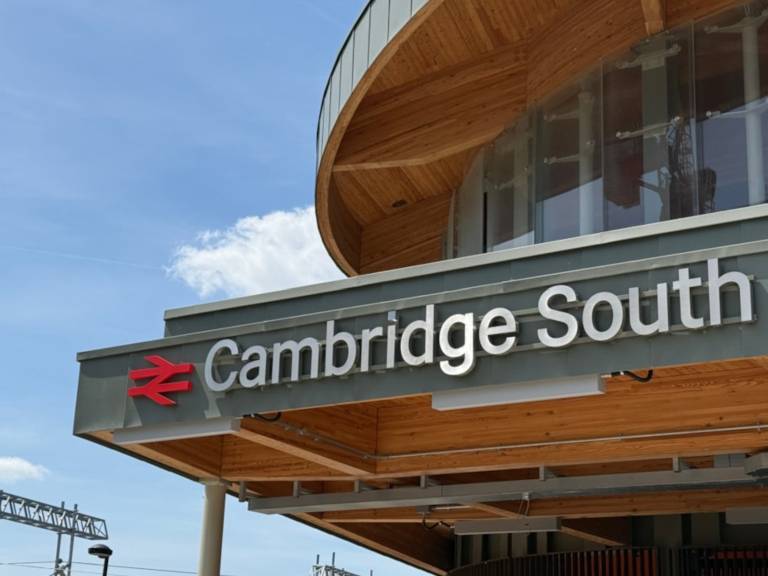
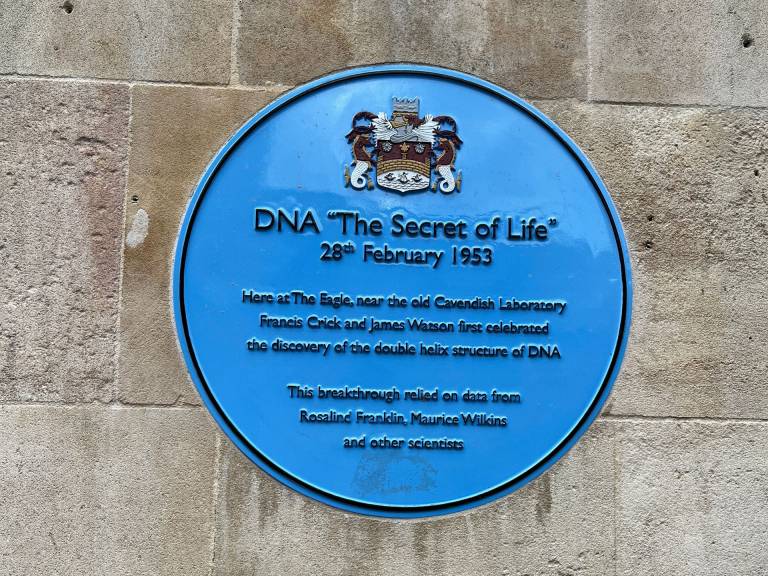
Step 4: Discover “The Secret of Life”
Walk to the end of Free School Lane and turn left into Bene’t Street. Opposite you is The Eagle Pub.
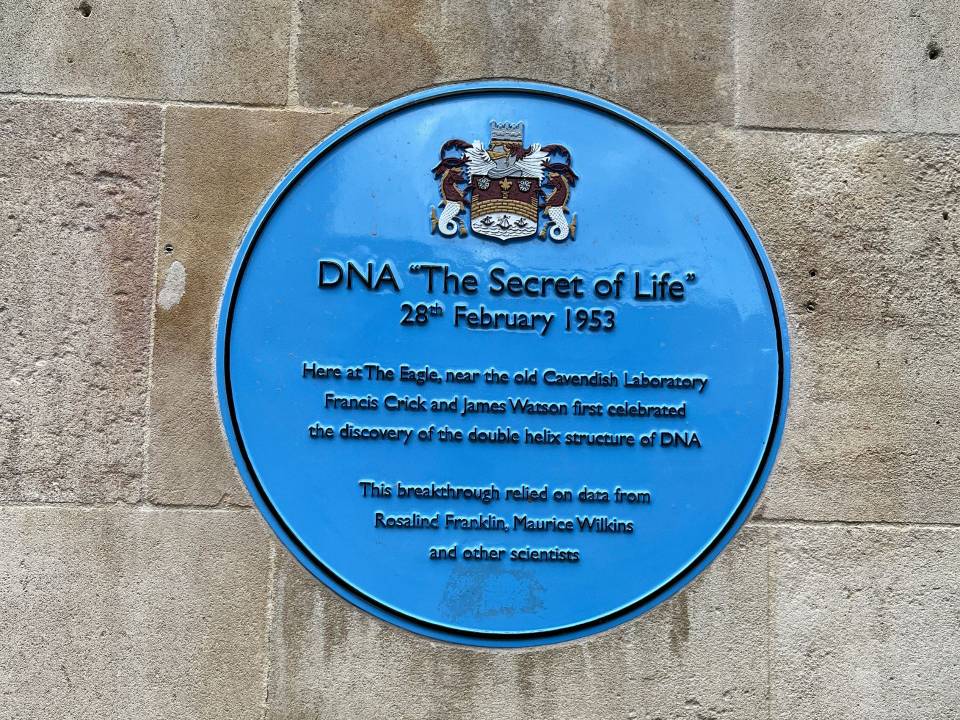
On 28 February 1953, Francis Crick announced to fellow diners that he and James Watson had “discovered the secret of life” after solving the structure of DNA. The event is commemorated by a plaque outside the pub.
Inside the pub near the back there is a golden plaque in memory of Rosalind Franklin, whose work enabled Crick and Watson’s discovery.
Why not stop for lunch or refreshments and reflect on one of the greatest scientific breakthroughs of modern times?
From the Eagle you can walk approximately half an hour back to Cambridge Station via Regent Street, Hills Road and Station Road, or return to Pembroke Street and catch the U1 bus back to the station.
BBC Bitesize Article on the Structure of DNADid you know?
A century before the structure of DNA was discovered, Charles Darwin, another famous Cambridge resident, explained how species evolve through natural selection. Scientists later discovered that DNA provides the mechanism by which inherited characteristics are passed from one generation to the next. Together, Darwin’s theory of evolution and the discovery of DNA transformed our understanding of life on Earth.
If you enjoyed this itinerary, please look out for our Cambridge Free Museums itinerary too.
More things to do at Shelford



Browse more things to do across the Cam Valley lines